
Table of Contents
There’s something quietly satisfying about picking up a book, opening the front page, and seeing your name written inside. It’s small, but it matters. It turns a mass-produced object into something that belongs to you, part of your story, your shelves, your collection.
Whether you’ve just bought a new novel, inherited a box of old paperbacks, want to protect your textbooks from disappearing in a shared office, or you’re looking for a creative way to label books as gifts, knowing how to write your name on a book properly makes a real difference. Do it well, and it looks intentional. Do it carelessly, and you’ll be staring at a crooked scrawl every time you open the cover.
This guide covers everything: where to write, what to write with, which method suits your style (including stamps, bookplates, printed labels, and more), and some genuinely creative ideas that go beyond just a first and last name.
Why Writing Your Name in a Book Still Matters
Before getting into the how, it’s worth spending a moment on the why because it’s not as trivial as it sounds.
Ownership is obvious. Books have a way of wandering off. Lend one to a friend, bring it to a book club, leave it in a classroom, and suddenly it’s just “a book,” not your book. A name inside changes that dynamic immediately.
It creates a paper trail for collections. If you have a hundred books or more, writing your name is the quickest way to catalog them as yours, especially useful if you share space with other readers or if books get mixed up during a move.
Books become keepsakes. A book with your name, a date, and maybe a brief note about where you were when you read it transforms into something worth keeping. Years later, finding that inscription can feel like discovering a small time capsule.
It adds provenance and character. Book collectors will tell you that a previous owner’s handwriting inside a book adds to its personality, not detracts from it. Some of the most interesting books in existence are interesting because of the names written inside them.
Where to Write Your Name on a Book
Placement is half the battle. Write in the wrong spot, and it either looks clumsy or worse damages a page you actually care about.
The title page is the traditional and most widely accepted location. It’s the first proper page with text on it (not the blank endpaper), and it’s where ownership inscriptions have been placed for centuries. There’s usually enough white space above or below the title for a name to sit naturally without competing with the printed text.
The front endpaper (front flyleaf) is the blank page directly inside the front cover, the first thing you see when you open the book. This is a great spot if you want more room for a longer inscription, a date, or a gift message. Many bookplates are placed here, too.
The front inside cover works when there’s no flyleaf, common in cheaper paperbacks. Writing directly on the inside cover is perfectly fine, though it can feel slightly informal for hardcovers.
Page edges (the fore-edge or top edge) is an older technique where you write your surname along the closed edges of the pages. It looks bold and is immediately visible when the book is on a shelf, but it’s a commitment. Not subtle at all. Think of it as the “loud” approach.
What to avoid: Writing on the copyright page or over any printed text looks careless. Avoid the back cover entirely; it’s not conventional, and it tends to look out of place.
Method 1: Writing by Hand (The Classic Approach)
For most people, most of the time, handwriting your name is the obvious choice. It’s personal, immediate, and costs nothing. But the difference between a name that looks confident and one that looks rushed comes down to a few easy decisions.
One thing worth settling before you put pen to paper: decide exactly how you want to write your name, and keep it consistent. How you format your name, whether that’s full name, initials plus surname, or a nickname, matters more than most people expect, especially if you’re labeling an entire collection over time. Inconsistency across dozens of books looks like a lack of intention.
Choosing the Right Pen
This matters more than people realize. The wrong pen bleeds through thin pages, fades within a year, or smears before it even dries.
- Fine-tip ballpoint (0.5mm–0.7mm): The safest option for most books. Ballpoints don’t bleed, they dry instantly, and they hold up for decades. A Pilot G2, Uni-ball Jetstream, or Staedtler ballpoint are all reliable choices.
- Archival-quality pigment ink pen: If you care about permanence, especially in hardcovers or collectible editions, a pigment-based ink pen (like the Micron Pigma or a Staedtler Triplus) won’t fade or yellow over time the way dye-based inks can.
- Fine-tip felt pen: Works well for decorative scripts, but test it on scrap paper first. Some felt tips bleed into absorbent paper.
- Gel pen: Good flow and clean lines, but give it 30–60 seconds to fully dry before closing the book — especially on glossy or coated endpapers.
- Fountain pen: Genuinely beautiful for inscriptions. Use it if you have one and enjoy the aesthetic. Just be careful on thin or cheap paper, fountain pen ink can feather noticeably.
What to avoid: Marker pens (too bold and they bleed), permanent markers like Sharpies unless the paper is thick, and anything water-soluble if the book might ever get damp.
What to Write (and How Much)
Your name alone is completely sufficient. Just “Jane Thornton” written cleanly in the upper portion of the title page looks polished and clear.
But you can add more if you want:
- Name + date: “Jane Thornton, March 2024” This small addition makes the inscription a record of when the book entered your life.
- Name + date + place: “Jane Thornton Lisbon, July 2023” is particularly nice for books bought on trips or holidays.
- Name + brief note: “Jane Thornton. Read during the pandemic. One of the strangest years of my life.” This is more journal-like, but some people love it. It turns the book into a personal artifact.
Practical Tips for Neat Results
- Practice on a scrap piece of paper with the same pen first, especially if you’re using a new tool.
- Take your time. Rushing is the main reason inscriptions look messy.
- If you’re writing on an endpaper that has a slight sheen, pressing a ballpoint pen with heavy pressure on glossy paper can leave embossing marks on the page beneath.
- Center your name visually, or align it to the left margin. Both look intentional; random placement in the middle of a page looks accidental.
Method 2: Using a Book Stamp
If you have a decent-sized personal library, handwriting your name in every single book gets old fast. A custom book stamp solves that problem elegantly, and it looks fantastic.
What Is an Ex Libris Stamp?
The phrase ex libris is Latin for “from the library of.” These stamps have been used to mark book ownership since the 15th century. Traditional bookplates were elaborate engraved labels commissioned by wealthy collectors; today’s version is much more accessible, a custom rubber stamp, often featuring the owner’s name alongside a small design, symbol, or decorative border.
A good stamp creates a clean, consistent imprint every time. Press it once onto the title page or inside front cover, and you’re done in seconds.
Types of Book Stamps
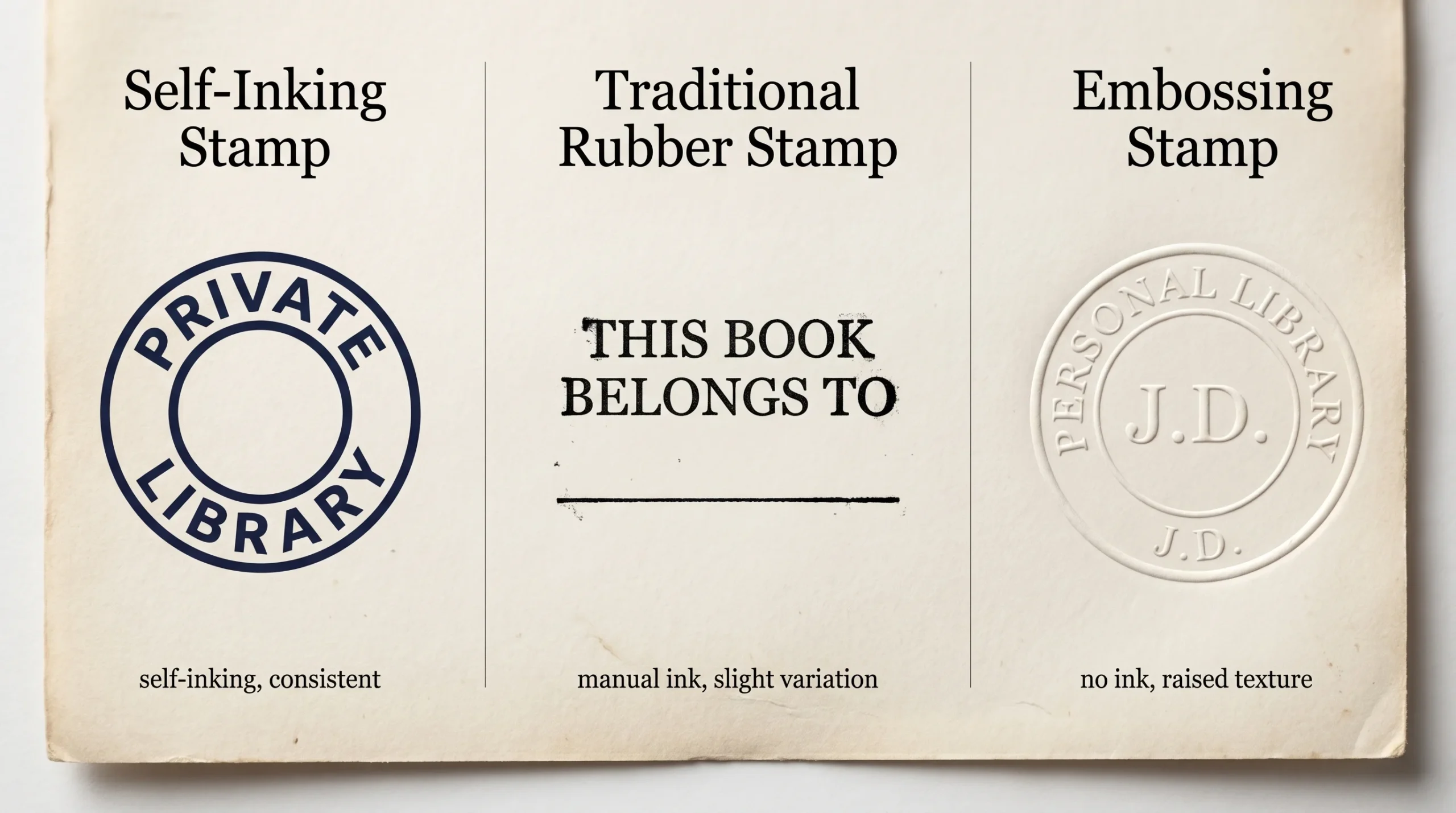
Self-inking stamps are the most convenient. They re-ink themselves automatically with each use, and the imprint is consistently crisp. Perfect for large libraries.
Traditional rubber stamps with a separate ink pad give you more control over ink color and pressure. Slower to use, but better suited to decorative or colorful designs.
Embossing stamps (no ink) create a raised, embossed impression rather than an inked mark. The result is very elegant, almost invisible at first glance until the light catches it, and it doesn’t risk bleeding or smearing. Preferred by collectors who don’t want visible ink on valuable books.
Where to Get One
Sites like Etsy, Zazzle, RubberStamps.com, and Stamprints offer fully customizable book stamps. You can typically choose the text (your name, a phrase like “From the Library of”), a font, and a design motif, anything from simple geometric borders to illustrated bookworms, maps, or literary motifs.
Custom stamps typically cost between $15 and $40, depending on complexity, and they last for thousands of impressions. If you own more than 50 books, it’s easily worth the investment.
Method 3: Bookplates and Adhesive Labels
A bookplate is a label, traditionally a printed or illustrated sticker that gets affixed to the inside front cover or first endpaper of a book. It’s one of the oldest and most visually satisfying ways to mark book ownership.
Pre-Printed Bookplates
You can buy packs of blank bookplates in various designs from stationery shops, Amazon, or Etsy. They typically read “This Book Belongs To” or “From the Library of” with a space to write your name. Peel, stick, sign, that’s it.
These are especially practical for:
- Lending libraries at home
- School books or children’s collections
- Families with multiple readers in the same household
Custom-Printed Bookplates
If you want something more personal, services like Minted, Artifact Uprising, or various Etsy shops will print bookplates with your name already on them, or with any design, color scheme, or illustration you choose. A set of 30–50 custom bookplates costs roughly $10–$25.
This is also a wonderful gift idea. A set of personalized bookplates for a fellow reader is thoughtful, useful, and genuinely original.
Printed Address Labels (The Practical Shortcut)
Older generations may remember ordering rolls of personalized return address labels for correspondence. The same small labels work perfectly as book ownership markers. You can print a sheet at home in minutes using Avery label templates and whatever word processor you have. Print your name, maybe add a small icon, and you have 30 labels ready to go.
Not the most elegant option, but entirely functional and practically free.
Method 4: Digital and Printed Methods
For people who want a more polished look without investing in custom stamps or bookplates, there are some simple digital approaches worth knowing about.
Design Your Own Bookplate (Free Tools)
Canva, Adobe Express, and similar free design tools have bookplate templates. You can customize one with your name, a background, a small illustration, whatever suits your aesthetic, then print a sheet of them on adhesive label paper at home.
The result looks completely custom and costs almost nothing beyond the paper. Avery label sheets (size 2″×3.5″ or similar) work well for this.
QR Code Labels
This one is genuinely useful for avid lenders: create a free QR code linked to your contact information (a simple Google Form or a link to your email), print it as a small sticker, and affix it inside the cover alongside your name. If the book ends up in someone else’s hands, they have a direct way to contact you.
It sounds overly technical, but it takes about 10 minutes to set up and is surprisingly practical for books you regularly lend out.
Creative and Aesthetic Ideas for Labeling Books
If you want to go beyond a plain name in blue ink, here are some ideas worth considering, especially for books you care about or plan to keep for a long time.
Use a nickname or a playful personal label. Not everyone wants to write their full legal name inside every book. Some readers use a nickname, a family name, or something more creative that reflects their personality, particularly for children’s book collections or shared household libraries where a bit of fun goes a long way.
Create a family library stamp. If you share books across generations, a shared family stamp (“The Henderson Family Library Est. 2010”) adds a real sense of tradition and identity to the collection. If you want to give your family’s library a name that makes people smile, a name with a bit of humor in it can make the whole ritual more memorable, especially for kids who are just building their first shelves.
Add a personal rating or reaction. Some readers write a brief verdict below their name: “Loved it. March 2022.” or “DNF at page 80, not for me.” In the future, you will thank the present you.
Include where you got the book. “Bought at Strand Bookstore, NYC” or “Found in a charity shop, Edinburgh.” Books acquired in interesting places deserve to have that noted.
Use a different color per year. If you’re a systematic type, write your name in red for books acquired in one year, blue the next, and so on. Over a decade, your shelves become a quiet visual record of your reading history.
Add a meaningful quote. Below your name on the endpaper, write a sentence that was meaningful to you. You’ll encounter it every time you pick up the book.
Writing Your Name in a Book as a Gift Inscription
If someone gives you a book or you’re giving one, the inscription inside is often what makes it memorable. A signed gift book that outlasts the relationship, the event, the occasion, that’s something genuinely special.
A good gift inscription usually includes:
- Who it’s from (and sometimes who it’s to, though that’s optional if it’s obvious)
- The occasion — “Your 30th birthday,” “First Christmas in the new house,” “For surviving the bar exam.”
- Something personal — a sentence about why you chose this book, why you thought of them, or what you hope they take from it
If you’re an author inscribing copies of your own book, whether to fans, friends, or family, the name you use matters too. Choosing the right name to put on the page is something writers spend a surprising amount of time thinking about, and your inscription is an extension of that identity.
An example of a great gift inscription:
For Alice who has read everything and somehow made me feel like I haven’t read enough. Happy birthday. This one is yours. Dan, September 2024
That takes thirty seconds to write and will be read a hundred times over the life of that book. Compare it to a blank page or a receipt tucked inside.
Common Mistakes to Avoid
Writing too large. A name that takes up half the page draws the eye for the wrong reasons. Keep it proportionate to the page; your name should look like a signature, not a headline.
Using the wrong ink. Washable inks fade; some markers bleed through to the next page; water-based inks can run if the book gets damp. Test new pens on scrap paper first.
Writing on the copyright page. It’s printed information that belongs to the publisher, not the place for your ownership mark. Stick to endpapers or the title page.
Pressing too hard. Heavy ballpoint pressure on thin paper can leave an embossed impression on the page beneath. Write with a light, consistent hand.
Overcrowding the inscription. The best book inscriptions are brief and intentional. Don’t try to write an essay; two or three lines carry more weight than a paragraph.
Writing in a borrowed book. This sounds obvious, but double-check before writing, especially with books borrowed during a move or received casually from someone.
FAQ: Labeling and Marking Your Books
Does writing my name in a book devalue it?
For most everyday books, no it doesn’t matter at all. For rare or collectible editions, it depends on context. Ownership inscriptions from notable people or historical figures can actually increase a book’s value. For a first edition of something genuinely rare, it’s worth preserving the book as pristine, or using a removable option like a loose bookplate.
What's the best pen for writing in books without bleeding through the page?
A fine-tip ballpoint (0.5mm–0.7mm) is the most reliable option for thin paper. It dries immediately and doesn’t bleed. For thicker endpapers, a fine-tip archival pigment pen works beautifully and is fade-resistant.
Where exactly should I write my name on the front or back?
The front endpaper or title page is conventional. It’s immediately visible and universally understood as the place for ownership inscriptions. The back of the book isn’t typically used for this purpose.
Can I remove a name that was already written in a book I bought secondhand?
Ink is difficult to remove without damaging the paper, and most methods erasers, solvents risk making things worse. Most readers simply leave the previous owner’s name and add their own beneath it. That layering of names can actually be charming in older books. If it bothers you, covering it with a bookplate is an elegant solution.
What's a bookplate and how is it different from just writing my name?
A bookplate (also called an ex libris) is a label, usually decorative, that’s affixed to the inside cover rather than written directly on the page. It achieves the same purpose (marking ownership) but can be removed without damaging the book, and it allows for more visual complexity: designs, motifs, personal illustrations. Writing directly is more personal and immediate; a bookplate is more formal and collectible. If you’re still deciding what name or identity to use for your bookplate, brainstorming a few creative name options before committing to a printed design is always a smart move.
Quick Reference: Choosing the Right Method
| Method | Best For | Cost | Permanence |
|---|---|---|---|
| Handwriting | Most situations; personal libraries | Free | Permanent |
| Book stamp | Large collections; consistent look | $15–$40 | Permanent |
| Pre-printed bookplates | Families; lending libraries | $5–$15 | Semi-permanent |
| Custom bookplates | Collectors; gifts; aesthetics | $10–$30 | Semi-permanent |
| Printed labels (DIY) | Budget-friendly; practical | Near-free | Semi-permanent |
| Embossing stamp | Valuable books; minimal marking | $20–$50 | Permanent |
| QR code sticker | Frequent lenders | Near-free | Removable |
Writing your name on a book is one of those small acts that seems almost too simple to think about until you realize how many options there actually are. And if you’re still searching for the right name to put on the page, these simple tips for generating creative and funny names can spark some fresh ideas.
Facebook
X
LinkedIn
Pinterest
-
How to Write Your Name on a Book (The Complete Guide 2026)
-

Bands With 5 in the Name
-

10 Essential Brand Name Normalization Rules
-

300+ Cool Anime Names for Boys and Girls
-
300+ Funny WiFi Names That Will Make You Laugh 😂 (2026)
-

150+ Funny Fantasy Football Names 2026 – Pick Now
-
Funny Names Generator | Create Random Funny Names Free!
-

Funny Names Like Ben Dover That Make People Laugh
-
How to Choose Realistic Character Names
-
Spanish Name Generator: A Simple Tool for Authentic Spanish Names